This summer, I was surprised to learn from manotv, a Persian TV based in England, that Google has launched its first series of four O3b satellites from French Guiana on June 25, 2013! [1] I am puzzled why this has not got more publicity in the U.S. media or maybe it did and I missed it. O3b Satellite Constellations is another project of Google aiming to connect people all over the world, similar to Google Loon Project, especially those in remote areas who currently do not have broadband internet access. The first of these satellites was built in France and the remaining ones was assembled,integrated, and tested in Italy. O3b satellites will fly in a circular orbit, about 8000 kilometers above the Earth, in medium Earth Orbit. A quick search reveals that Google is an investor of O3b Networks, along with other companies, to enabling next generation high speed satellite networks.
This is the beginning of a new era making the space and computing technologies come full circle. It was the space industry that enabled high performance computing via commodity computing and invented some computers for aerospace missions, and now it is the computing industry benefiting from the space industry.
References:
[1] http://gigaom.com/2013/06/25/google-backed-o3b-successfully-launches-its-first-four-satellites-into-the-heavens/
[2] http://gigaom.com/2013/06/24/googles-other-plan-to-connect-the-unconnected-satellites/
[3] http://en.wikipedia.org/wiki/NSSC-1
[4] http://spacejournal.ohio.edu/pdf/Dorband.pdf
[5] http://en.wikipedia.org/wiki/O3b_%28satellite%29
[6] http://www.o3bnetworks.com/
Showing posts with label technology. Show all posts
Showing posts with label technology. Show all posts
Monday, October 7, 2013

Sunday, September 15, 2013
LADEE
LADEE stands for Lunar Atmosphere and Dust Environment Explorer. It is the most recent of NASA's missions to moon, which was launched on Friday, September 6 from NASA Goddard's Wallops Flight Facility in VA.. It is a robotic mission for orbiting moon and studying its dust environment and exosphere.
In addition to scientific results of LADEE, this mission was important for several other reasons, mainly new technologies and capabilities that were demonstrated and tested during this mission. The mission used a Minotaur V rocket of the Orbital Sciences, that is expected to be used in future launches [5]. Furthermore, Lunar Laser Communication Demonstration (LLCD) mission is achieved via LADEE. This demonstration is the first high-rate, two-way space communication capability, a major advancement in space communication. Both of these capabilities opens doors to future faster cheaper space missions with more and faster science data rates. Finally it was the first time that Wallops Flight Facility launched something that can reach moon, and one hopes that this facility's capabilities mature and advance even more in the future.
The mission is managed by NASA Ames Research Center, flown by Orbital Sciences at Wallops Flight Center, while some of its instruments as well as LLCD technology were managed and developed at NASA's Goddard Space Flight Center [6]. The mission was visible on the east coast of the United States from VA, to MD, DC, and even NY. Here is a nice image of LADEE on its way to the moon from New York City:
Go LADEE!
References:
[1] http://www.nasa.gov/mission_pages/ladee/main/#.UjY5838pid0
[2] http://science1.nasa.gov/missions/ladee/
[3] http://www.nasa.gov/mission_pages/ladee/mission-overview/index.html#.UjY8a38pid1
[4] http://esc.gsfc.nasa.gov/267/271.html
[5] http://www.orbital.com/NewsInfo/MissionUpdates/MinotaurV/index.shtml
[6] http://www.redorbit.com/news/space/1112928749/major-role-played-nasa-goddard-lunar-mission-082113/
"An “exosphere” is an atmosphere that is so thin and tenuous that molecules don’t collide with each other. Studying the Moon’s exosphere will help scientists understand other planetary bodies with exospheres too, like Mercury and some of Jupiter’s bigger moons." [2]It takes one month for LADEE to get to moon's orbit. Then, the 100-day Science Phase of the mission, during which LADEE orbits the moon at an altitude of 20-60 kilometers from the moon, starts. Finally, LADEE's lowers its altitude and impacts the moon. This final stage takes 30 days, resulting in a total mission lifetime of 160 days.
In addition to scientific results of LADEE, this mission was important for several other reasons, mainly new technologies and capabilities that were demonstrated and tested during this mission. The mission used a Minotaur V rocket of the Orbital Sciences, that is expected to be used in future launches [5]. Furthermore, Lunar Laser Communication Demonstration (LLCD) mission is achieved via LADEE. This demonstration is the first high-rate, two-way space communication capability, a major advancement in space communication. Both of these capabilities opens doors to future faster cheaper space missions with more and faster science data rates. Finally it was the first time that Wallops Flight Facility launched something that can reach moon, and one hopes that this facility's capabilities mature and advance even more in the future.
The mission is managed by NASA Ames Research Center, flown by Orbital Sciences at Wallops Flight Center, while some of its instruments as well as LLCD technology were managed and developed at NASA's Goddard Space Flight Center [6]. The mission was visible on the east coast of the United States from VA, to MD, DC, and even NY. Here is a nice image of LADEE on its way to the moon from New York City:

Go LADEE!
References:
[1] http://www.nasa.gov/mission_pages/ladee/main/#.UjY5838pid0
[2] http://science1.nasa.gov/missions/ladee/
[3] http://www.nasa.gov/mission_pages/ladee/mission-overview/index.html#.UjY8a38pid1
[4] http://esc.gsfc.nasa.gov/267/271.html
[5] http://www.orbital.com/NewsInfo/MissionUpdates/MinotaurV/index.shtml
[6] http://www.redorbit.com/news/space/1112928749/major-role-played-nasa-goddard-lunar-mission-082113/
Sunday, July 7, 2013
Google's aeronautical endeavors 1: Google Loon Project!
Google has changed our lives first with its search engines and then with so many services it offers to us from mail, blogs, docs, scholar, etc. All these enable fast paced research, knowledge sharing, collaboration, and above all connection among people! Now, Google is expanding its horizons even further by realizing that not all people in the world have access to broadband internet to be able to benefit from these services to begin with. So, they want to solve that problem too. I have recently learned about a couple of their efforts for providing free broadband internet to remote rural areas. The first one is Google's balloon project, Loon, aiming at providing internet access to underprivileged and disconnected (to internet that is) areas of the world. In this project Google launches balloons to a 20 km altitude. These balloons are powered with solar energy and their navigation algorithms consider and benefit from wind direction! They are much cheaper than launching satellites and can provide internet coverage for up to a 25 mile radius [2]! The balloons travel around the world. For example, the same balloon that was over South Africa will be over South America eventually [3].
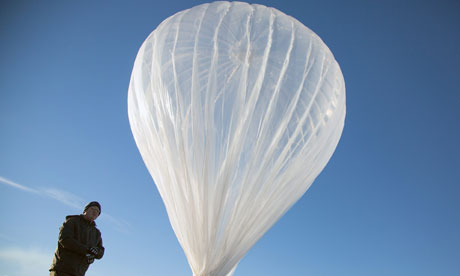
A Project Loon launch in New Zealand. Photograph: John Shenk/EPA", Source: the Gaurdian,
http://www.guardian.co.uk/technology/2013/jun/15/project-loon-google-balloon-internet
http://www.guardian.co.uk/technology/2013/jun/15/project-loon-google-balloon-internet
While the idea is smart and cost-effective, Google, like most big organizations and even countries, is beginning to learn that its hardest challenges are not technological [3-4]. The problem is beyond local, state, or governmental bureaucracy, it is international bureaucracy! [4] Loon project needs to cross borders of many countries with different politics and rules. For example, Texas and Tehran happen to be in the same altitude [3]. Will a Google balloon make its way to Iran's aerospace or China's? I am curious to see how Google manages to connect the world on internet! It seems like Google was well-aware and willing to take on these challenges and they chose this name, Loon, partly to recognize the strange and seemingly unrealistic goals they want to achieve! [5] Regardless, any new country and region they give broadband internet access to, be it in Africa or Asia, connecting children and adults to educational and informative resources, is a great service to humanity.
On June 16, 2013 Google started a trial of this project with 30 balloons over New Zealand! After this pilot run, Google plans on sending 300 balloons to cover areas in Argentina, Australia, New Zealand, and Chile, and later on Google dreams of having thousands of such balloons in stratosphere[5]
I talk about another Google effort for providing internet access to people all over the world in a second post.
To learn more about the Loon project please check out the references below.
References:
[1] http://www.google.com/loon/
[2] http://www.telegraph.co.uk/sponsored/technology/technology-trends/10162043/google-project-loon.html
[3] http://gigaom.com/2013/06/21/project-loon-googles-biggest-obstacle-isnt-technology-its-politics/
[4] http://www.forbes.com/sites/timworstall/2013/06/23/googles-project-loon-problem-international-bureaucracy/
[5] http://en.wikipedia.org/wiki/Project_Loon
[6] http://www.guardian.co.uk/technology/2013/jun/15/project-loon-google-balloon-internet
Monday, February 4, 2013
Behind the LASIK Eye
By now you should have learned that Baltimore Ravens have won the Super Bowl :-) I have learned a pleasantly surprising piece of information, rather late. Do you know who is the inventor of the LASIK eye surgery? Dr. Gholam Peyman! Learn more about him here:
http://en.wikipedia.org/wiki/Gholam_A._Peyman
And here:
http://www.infozine.com/news/stories/op/storiesView/sid/54753/
http://en.wikipedia.org/wiki/Gholam_A._Peyman
And here:
http://www.infozine.com/news/stories/op/storiesView/sid/54753/
Thursday, January 24, 2013
Keep Playing!
The game is on, and the job is to solve hard scientific problems. So, in future instead of blaming every bad incident to kids playing computer games too much, people associate scientific breakthroughs, better life quality, and technologies to it. Instead of kids getting more violent, they may get more innovative and creative, and learn a few things! How about that? Here are some existing games, aiming to solve hard scientific problems, according to the Scientist:
http://www.the-scientist.com//?articles.view/articleNo/33843/title/Game-On/
If all goes well, there will be another one added to this list, by truly yours, maybe next year?
Stay tuned, and keep playing the game of science, discovery, and exploration!
http://www.the-scientist.com//?articles.view/articleNo/33843/title/Game-On/
If all goes well, there will be another one added to this list, by truly yours, maybe next year?
Stay tuned, and keep playing the game of science, discovery, and exploration!
Monday, December 3, 2012
Time Reversal Process
Researchers at University of Maryland at College Park have come up with a new technique that has the potential of making many science-fiction scenarios, realities of everyday life.
"
Using a time-reversal technique, the team has discovered how to transmit power, sound or images to a nonlinear object without knowing the object 's exact location and without affecting objects around it.
"
That means one day you can charge your cell phone remotely without any cable, without even knowing where your cell phone is! and many other cool applications! Learn more here.
"
Using a time-reversal technique, the team has discovered how to transmit power, sound or images to a nonlinear object without knowing the object 's exact location and without affecting objects around it.
"
That means one day you can charge your cell phone remotely without any cable, without even knowing where your cell phone is! and many other cool applications! Learn more here.
Thursday, November 15, 2012
Ruby on Rails
Today I learned about Ruby on Rails programming language for the first time!
http://rubyonrails.org
Apparently, this is what Zooniverse uses.
Do you know about this programming language? What is its advantage over say Java? Is it hard to learn and use?
Sunday, October 30, 2011
Captcha and Duolingo!
Most of you must know what Captchas are (even if you have not heard the term) and have spent some time deciphering and typing what they display. They often are distorted words you see as figures and need to type, when paying a bill or making a comment online, ... so that a website verifies it is indeed a human filling out a form, doing a transaction, or making a comment and not an automatic computer program. Sometimes, it is hard for me to decipher what one of the words is to type and have to ask for a different Captcha before I succeed. Sometimes they are annoying, sometimes you think you are wasting time. This bothered captcha's inventor as well and motivated him to do something else with them.
Yesterday, I attended the 2011 TEDxMidAtlantic. Another wonderful event, with enthusiastic and passionate speakers and audience. A whole building full of enough positive energy to keep you going till the next year's conference. Among the speakers was Luis von Ahn, the inventor of Captcha, founder of reCaptcha, and a computer science professor at Carnegie Mellon University.
So it turns out we spend about 10 seconds every time we type a captcha, and that people around the world all together type about 200 million captchas a day, that is over 5000 hours a day. So, Luis von Ahn thought is there a harder problem that could be mapped and translated to typing captchas, so that by filling out the forms and doing transactions online people actually spend that 10 precious seconds doing something worthwhile, and solving a hard computational problem?
In fact there exists such a problem: digitizing books. Many old books have weird fonts, washed out words, or ones that are dragged across the paper over the years, in a way that it is very hard for computers to automatically understand them. For humans, on the other hand, that is an easy task. So, what do they do? They provide one of the words from the books they are digitizing to you in a captcha. However, since the point of the captcha was to verify you were in fact a human, they cannot test you with something that the computer does not know the answer to. So, they ask you to type two words: one is the word they know what it is and they can correctly verify your answer, and the other the one they are asking you to recognize to help them digitize books. They also gain some confidence when you type the word that they know what it should be. Then, when enough people distinguished the ambiguous word the same way you did, they declare it digitized. They continue the same process word by word, line by line, page by page, book after book. So, the next time you get frustrated digitizing books, do not! You are doing something great for free!
p.s. You can also learn a new language while helping translate the whole web! Brilliant idea by the same person on Duolingo!
References:
[1] Captcha
[2] reCaptcha
[2] Duolingo.
[3] Luis von Ahn.
Yesterday, I attended the 2011 TEDxMidAtlantic. Another wonderful event, with enthusiastic and passionate speakers and audience. A whole building full of enough positive energy to keep you going till the next year's conference. Among the speakers was Luis von Ahn, the inventor of Captcha, founder of reCaptcha, and a computer science professor at Carnegie Mellon University.
So it turns out we spend about 10 seconds every time we type a captcha, and that people around the world all together type about 200 million captchas a day, that is over 5000 hours a day. So, Luis von Ahn thought is there a harder problem that could be mapped and translated to typing captchas, so that by filling out the forms and doing transactions online people actually spend that 10 precious seconds doing something worthwhile, and solving a hard computational problem?
In fact there exists such a problem: digitizing books. Many old books have weird fonts, washed out words, or ones that are dragged across the paper over the years, in a way that it is very hard for computers to automatically understand them. For humans, on the other hand, that is an easy task. So, what do they do? They provide one of the words from the books they are digitizing to you in a captcha. However, since the point of the captcha was to verify you were in fact a human, they cannot test you with something that the computer does not know the answer to. So, they ask you to type two words: one is the word they know what it is and they can correctly verify your answer, and the other the one they are asking you to recognize to help them digitize books. They also gain some confidence when you type the word that they know what it should be. Then, when enough people distinguished the ambiguous word the same way you did, they declare it digitized. They continue the same process word by word, line by line, page by page, book after book. So, the next time you get frustrated digitizing books, do not! You are doing something great for free!
p.s. You can also learn a new language while helping translate the whole web! Brilliant idea by the same person on Duolingo!
References:
[1] Captcha
[2] reCaptcha
[2] Duolingo.
[3] Luis von Ahn.
Tuesday, September 20, 2011
Citizen Science: Discovery of Two New Planets
Scientific data sets grow at a faster pace than scientists can keep up with them, analyze them carefully, make discoveries, find trends, etc. For this reason Citizen Science, asking and involving citizen scientists and volunteers to perform scientific tasks, has become popular and essential. NASA has embraced the idea of Citizen Science and already has several active projects in which the public can participate. The tasks may vary from collecting ground truth data to finding hay in stacks (it is usually the second case).
One of the most successful citizen science projects of NASA is Zooniverse, composed of several projects like Moon Zoo, Planet Hunters, Galaxy Zoo, Solar Stormwatch, etc.
The SETI Institute, dedicated to finding extraterrestrial life, is asking citizens help find signals of others who might be out there in the universe, using setiQuest, by simply scrolling through signals and images and marking unusual activities and features!
Citizen Science has multiple benefits. In addition to the increased work force and chance of making scientific discoveries, it is educational and inspirational for students and a good tool for educators. In addition, it shows the taxpayer the value of the scientific projects by engaging them in the process, and as a result securing various missions and projects. If government decides to cut the budget on a mission, which the public around the globe is extremely invested in and supportive of, chances are very slim. This was the case for Hubble and its beautiful imagery.
We are already seeing the value of the citizen science. Two new planets, possibly habitable, were discovered by citizen scientists participating in Planet Hunting project! There is much more to be found and learned about.
How can you benefit from citizen science in your work and project? Can you interest and engage the public to help you? The public can be students, researchers, and professors all over the world in your field, anyone outside your own organization.
One of the most successful citizen science projects of NASA is Zooniverse, composed of several projects like Moon Zoo, Planet Hunters, Galaxy Zoo, Solar Stormwatch, etc.
The SETI Institute, dedicated to finding extraterrestrial life, is asking citizens help find signals of others who might be out there in the universe, using setiQuest, by simply scrolling through signals and images and marking unusual activities and features!
Citizen Science has multiple benefits. In addition to the increased work force and chance of making scientific discoveries, it is educational and inspirational for students and a good tool for educators. In addition, it shows the taxpayer the value of the scientific projects by engaging them in the process, and as a result securing various missions and projects. If government decides to cut the budget on a mission, which the public around the globe is extremely invested in and supportive of, chances are very slim. This was the case for Hubble and its beautiful imagery.
We are already seeing the value of the citizen science. Two new planets, possibly habitable, were discovered by citizen scientists participating in Planet Hunting project! There is much more to be found and learned about.
How can you benefit from citizen science in your work and project? Can you interest and engage the public to help you? The public can be students, researchers, and professors all over the world in your field, anyone outside your own organization.
Friday, September 16, 2011
The America Invents Act
President Obama signs the America Invents Act today, a major change to the U.S. patent laws. By this new regulation, patents will go to the first innovator who filed the application, as opposed to the one who first made the invention without reporting it. It prevents inventors from coming out and claiming the invention, and I assume it prevents so many lawsuits, court, and lawyer fees. I am thinking some firms whose jobs is to challenge and fight for an existing patents may go out of business!
Reference:
http://whitehouse.blogs.cnn.com/2011/09/16/obamas-day-ahead-the-america-invents-act/?iref=allsearch
Reference:
http://whitehouse.blogs.cnn.com/2011/09/16/obamas-day-ahead-the-america-invents-act/?iref=allsearch
Friday, September 9, 2011
4G Communications and more
I attended another IAAP lecture on 4G Wireless Communications [1]. We hear the term 3G and 4G, etc., but what does characterize 4G technology? Several properties: mobility, which immediately requires it being wireless, broadband (being able to send and receive different types of data), speed, and adhering to requirements of International Telecommunications Union (ITU), a division of United Nation, where telecommunication leaders of all countries meet and set the requirements and standards.
We also learned about how different carriers use different frequencies of the spectrum to avoid interferences. The speaker talked about some companies fighting with agencies such as FAA because their technologies are using frequencies very close to the boundaries of the frequency ranges that are used for GPS technology for aviation for example, among other applications. These concerns have led to deployment of a website for avoiding such problems, called Save Our GPS! [2]
As the time for questions and answers came, and as the topic of interference and FAA came up and there was at least one telecommunication expert in the room, I had to ask about the regulations restricting cell phone use on planes. Even though the speaker was not very happy with all the restrictions FAA puts on telecommunication companies, he immediately answered by saying the minimum effect cell phones on planes have is that they add background noise to the signals. In an ideal case, we expect all devices to use only the frequencies they are designed for. If that happens, there would be no problem. But other times, a technology such as cell phone may try another modulation of the frequency it is designed for, in which case it might be the same frequency that a device on plane is using, and thus cause interference. He suggested you can see the effects of your cell phones interference when you walk in front of your TV using it. I always think about how easily interferences or another problem, not receiving a signal, can occur by thinking about old fashioned radios we had back home. If we moved in front of it or moved the antenna a little here or there, it affected the performance of the radio. So does throwing in more signals, noise, static, or parazit at it.
[1] http://www.iaadc.net/2011/09/lecture-41-4g-wireless-communications/
[2] http://www.saveourgps.org/
We also learned about how different carriers use different frequencies of the spectrum to avoid interferences. The speaker talked about some companies fighting with agencies such as FAA because their technologies are using frequencies very close to the boundaries of the frequency ranges that are used for GPS technology for aviation for example, among other applications. These concerns have led to deployment of a website for avoiding such problems, called Save Our GPS! [2]
As the time for questions and answers came, and as the topic of interference and FAA came up and there was at least one telecommunication expert in the room, I had to ask about the regulations restricting cell phone use on planes. Even though the speaker was not very happy with all the restrictions FAA puts on telecommunication companies, he immediately answered by saying the minimum effect cell phones on planes have is that they add background noise to the signals. In an ideal case, we expect all devices to use only the frequencies they are designed for. If that happens, there would be no problem. But other times, a technology such as cell phone may try another modulation of the frequency it is designed for, in which case it might be the same frequency that a device on plane is using, and thus cause interference. He suggested you can see the effects of your cell phones interference when you walk in front of your TV using it. I always think about how easily interferences or another problem, not receiving a signal, can occur by thinking about old fashioned radios we had back home. If we moved in front of it or moved the antenna a little here or there, it affected the performance of the radio. So does throwing in more signals, noise, static, or parazit at it.
[1] http://www.iaadc.net/2011/09/lecture-41-4g-wireless-communications/
[2] http://www.saveourgps.org/
Tuesday, September 6, 2011
World's Smallest Electric Motor
If you work with Micro-Electro-Mechanical (MEMS) devices and you thought that was so cool, you are way out of touch with the latest and greatest (well, not in size) technology! How small do you think is the world's smallest technology? The previous record was 200 nanometers, while a single strand of hair is about 60,000 nanometers!
Now, researchers in Tufts university have built the smallest electric motor, which is one nanometer in size! We humans can now build and control something that small, and at the same time see things millions of light years away. Mind boggling, is not it?
Reference:
http://www.sciencedaily.com/releases/2011/09/110904140353.htm
Now, researchers in Tufts university have built the smallest electric motor, which is one nanometer in size! We humans can now build and control something that small, and at the same time see things millions of light years away. Mind boggling, is not it?
Reference:
http://www.sciencedaily.com/releases/2011/09/110904140353.htm
Subscribe to:
Posts (Atom)