This summer, I was surprised to learn from manotv, a Persian TV based in England, that Google has launched its first series of four O3b satellites from French Guiana on June 25, 2013! [1] I am puzzled why this has not got more publicity in the U.S. media or maybe it did and I missed it. O3b Satellite Constellations is another project of Google aiming to connect people all over the world, similar to Google Loon Project, especially those in remote areas who currently do not have broadband internet access. The first of these satellites was built in France and the remaining ones was assembled,integrated, and tested in Italy. O3b satellites will fly in a circular orbit, about 8000 kilometers above the Earth, in medium Earth Orbit. A quick search reveals that Google is an investor of O3b Networks, along with other companies, to enabling next generation high speed satellite networks.
This is the beginning of a new era making the space and computing technologies come full circle. It was the space industry that enabled high performance computing via commodity computing and invented some computers for aerospace missions, and now it is the computing industry benefiting from the space industry.
References:
[1] http://gigaom.com/2013/06/25/google-backed-o3b-successfully-launches-its-first-four-satellites-into-the-heavens/
[2] http://gigaom.com/2013/06/24/googles-other-plan-to-connect-the-unconnected-satellites/
[3] http://en.wikipedia.org/wiki/NSSC-1
[4] http://spacejournal.ohio.edu/pdf/Dorband.pdf
[5] http://en.wikipedia.org/wiki/O3b_%28satellite%29
[6] http://www.o3bnetworks.com/
Showing posts with label computer. Show all posts
Showing posts with label computer. Show all posts
Monday, October 7, 2013

Sunday, July 7, 2013
Google's aeronautical endeavors 1: Google Loon Project!
Google has changed our lives first with its search engines and then with so many services it offers to us from mail, blogs, docs, scholar, etc. All these enable fast paced research, knowledge sharing, collaboration, and above all connection among people! Now, Google is expanding its horizons even further by realizing that not all people in the world have access to broadband internet to be able to benefit from these services to begin with. So, they want to solve that problem too. I have recently learned about a couple of their efforts for providing free broadband internet to remote rural areas. The first one is Google's balloon project, Loon, aiming at providing internet access to underprivileged and disconnected (to internet that is) areas of the world. In this project Google launches balloons to a 20 km altitude. These balloons are powered with solar energy and their navigation algorithms consider and benefit from wind direction! They are much cheaper than launching satellites and can provide internet coverage for up to a 25 mile radius [2]! The balloons travel around the world. For example, the same balloon that was over South Africa will be over South America eventually [3].
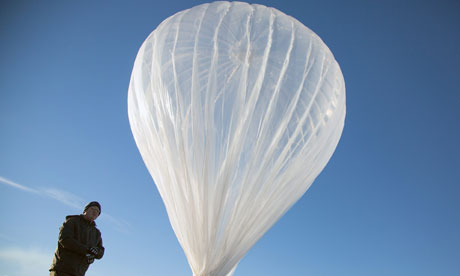
A Project Loon launch in New Zealand. Photograph: John Shenk/EPA", Source: the Gaurdian,
http://www.guardian.co.uk/technology/2013/jun/15/project-loon-google-balloon-internet
http://www.guardian.co.uk/technology/2013/jun/15/project-loon-google-balloon-internet
While the idea is smart and cost-effective, Google, like most big organizations and even countries, is beginning to learn that its hardest challenges are not technological [3-4]. The problem is beyond local, state, or governmental bureaucracy, it is international bureaucracy! [4] Loon project needs to cross borders of many countries with different politics and rules. For example, Texas and Tehran happen to be in the same altitude [3]. Will a Google balloon make its way to Iran's aerospace or China's? I am curious to see how Google manages to connect the world on internet! It seems like Google was well-aware and willing to take on these challenges and they chose this name, Loon, partly to recognize the strange and seemingly unrealistic goals they want to achieve! [5] Regardless, any new country and region they give broadband internet access to, be it in Africa or Asia, connecting children and adults to educational and informative resources, is a great service to humanity.
On June 16, 2013 Google started a trial of this project with 30 balloons over New Zealand! After this pilot run, Google plans on sending 300 balloons to cover areas in Argentina, Australia, New Zealand, and Chile, and later on Google dreams of having thousands of such balloons in stratosphere[5]
I talk about another Google effort for providing internet access to people all over the world in a second post.
To learn more about the Loon project please check out the references below.
References:
[1] http://www.google.com/loon/
[2] http://www.telegraph.co.uk/sponsored/technology/technology-trends/10162043/google-project-loon.html
[3] http://gigaom.com/2013/06/21/project-loon-googles-biggest-obstacle-isnt-technology-its-politics/
[4] http://www.forbes.com/sites/timworstall/2013/06/23/googles-project-loon-problem-international-bureaucracy/
[5] http://en.wikipedia.org/wiki/Project_Loon
[6] http://www.guardian.co.uk/technology/2013/jun/15/project-loon-google-balloon-internet
Wednesday, November 2, 2011
A Sense of Place
The theme for this year's TEDxMidAtlantic conference was "A Sense of Place":
"Our existence is defined through our experience of place: our place on Earth, in the universe, in culture, and in time. Understanding place is critical to the spread of knowledge, ideas and to progress. From the smallest sub-atomic particles to cities, to galaxies and undersea mountain ranges, everything has a place. TEDxMidAtlantic 2011 celebrates and explores place, mobility, context, and locality – and humanity's ongoing desire to achieve a sense of place."
What we learned more and more as the day progressed, was not only that we do not understand and appreciate our place on Earth, universe, and culture properly, rather that we have lost a sense of community and belonging in our local neighborhoods, workplaces, schools, and cities. We do not embrace what each individual has to offer and bring to the table to build better communities rather we keep alienating and ignoring them. The Wire cast shared their experiences of growing up in poor areas of Baltimore, Brooklyn, and Washington D.C. and how after thirty years not only things have not changed for the better, but that they also have lost the sense of community in those neighborhoods, their only shelter and protection against violence and poverty, their only source of hope and encouragement.
In fact, I learned a disturbing fact from Rebecca Renard of DC's Public Libraries who noticed teenagers out of school with no work hanging around in her library without receiving any love, care, education, and attention. She mentioned that how people who lived, worked, and commuted to/from the Gallery Place China town area in D.C. were bothered with noisy loitering teenagers in the area and complained to city officials about them. What was the city's solution to that problem? Get rid of them! They installed Mosquito noise devices at Gallery Place China town, a noise that only teenagers' ears were sensitive to [1]. I cannot think of a more humiliating and offensive approach to the youth. Instead of trying to employ and educate them, the city sent them away to make them someone else's problem, and then they are surprised by seeing gangs and crime rates increasing. It is a sad story for the so called capital of the free world* int the 21st century!
Rebecca Renard recognized all the potential, talent, and energy that was being wasted daily by teenagers hanging around in her library and city. She made a social network aimed for teenagers to learn about activities of value and interest to them, to learn from each other, and run a radio together [2]! She engaged them, created a welcoming and supportive environment for them, and let them shine and grow. Something city officials should have done.
National Youth Rights Association filed a complaint and had the noise maker devices removed, but the youth problems and their need for care and attention remains [3].
Do you know your neighbors? Their kids? Your kids' school friends and teachers? Do you have a good community? Are you of any value to your local communities? What are you waiting for?
References:
[1] Mosquito noise device at Gallery Place aims to annoy potential troublemakers
[2] Generation PRX, Youth Radio Producer's Hub.
[3] DC City Council: Fight Youth Crime, Not Youth
[4] Rebecca Renard
* A slogan of one of D. C. area's radio stations.
"Our existence is defined through our experience of place: our place on Earth, in the universe, in culture, and in time. Understanding place is critical to the spread of knowledge, ideas and to progress. From the smallest sub-atomic particles to cities, to galaxies and undersea mountain ranges, everything has a place. TEDxMidAtlantic 2011 celebrates and explores place, mobility, context, and locality – and humanity's ongoing desire to achieve a sense of place."
What we learned more and more as the day progressed, was not only that we do not understand and appreciate our place on Earth, universe, and culture properly, rather that we have lost a sense of community and belonging in our local neighborhoods, workplaces, schools, and cities. We do not embrace what each individual has to offer and bring to the table to build better communities rather we keep alienating and ignoring them. The Wire cast shared their experiences of growing up in poor areas of Baltimore, Brooklyn, and Washington D.C. and how after thirty years not only things have not changed for the better, but that they also have lost the sense of community in those neighborhoods, their only shelter and protection against violence and poverty, their only source of hope and encouragement.
In fact, I learned a disturbing fact from Rebecca Renard of DC's Public Libraries who noticed teenagers out of school with no work hanging around in her library without receiving any love, care, education, and attention. She mentioned that how people who lived, worked, and commuted to/from the Gallery Place China town area in D.C. were bothered with noisy loitering teenagers in the area and complained to city officials about them. What was the city's solution to that problem? Get rid of them! They installed Mosquito noise devices at Gallery Place China town, a noise that only teenagers' ears were sensitive to [1]. I cannot think of a more humiliating and offensive approach to the youth. Instead of trying to employ and educate them, the city sent them away to make them someone else's problem, and then they are surprised by seeing gangs and crime rates increasing. It is a sad story for the so called capital of the free world* int the 21st century!
Rebecca Renard recognized all the potential, talent, and energy that was being wasted daily by teenagers hanging around in her library and city. She made a social network aimed for teenagers to learn about activities of value and interest to them, to learn from each other, and run a radio together [2]! She engaged them, created a welcoming and supportive environment for them, and let them shine and grow. Something city officials should have done.
National Youth Rights Association filed a complaint and had the noise maker devices removed, but the youth problems and their need for care and attention remains [3].
Do you know your neighbors? Their kids? Your kids' school friends and teachers? Do you have a good community? Are you of any value to your local communities? What are you waiting for?
References:
[1] Mosquito noise device at Gallery Place aims to annoy potential troublemakers
[2] Generation PRX, Youth Radio Producer's Hub.
[3] DC City Council: Fight Youth Crime, Not Youth
[4] Rebecca Renard
* A slogan of one of D. C. area's radio stations.
Subscribe to:
Posts (Atom)