Sunday, December 29, 2013

Monday, October 7, 2013
Google's aeronautical endevours 2: O3b satellites!
This summer, I was surprised to learn from manotv, a Persian TV based in England, that Google has launched its first series of four O3b satellites from French Guiana on June 25, 2013! [1] I am puzzled why this has not got more publicity in the U.S. media or maybe it did and I missed it. O3b Satellite Constellations is another project of Google aiming to connect people all over the world, similar to Google Loon Project, especially those in remote areas who currently do not have broadband internet access. The first of these satellites was built in France and the remaining ones was assembled,integrated, and tested in Italy. O3b satellites will fly in a circular orbit, about 8000 kilometers above the Earth, in medium Earth Orbit. A quick search reveals that Google is an investor of O3b Networks, along with other companies, to enabling next generation high speed satellite networks.
This is the beginning of a new era making the space and computing technologies come full circle. It was the space industry that enabled high performance computing via commodity computing and invented some computers for aerospace missions, and now it is the computing industry benefiting from the space industry.
References:
[1] http://gigaom.com/2013/06/25/google-backed-o3b-successfully-launches-its-first-four-satellites-into-the-heavens/
[2] http://gigaom.com/2013/06/24/googles-other-plan-to-connect-the-unconnected-satellites/
[3] http://en.wikipedia.org/wiki/NSSC-1
[4] http://spacejournal.ohio.edu/pdf/Dorband.pdf
[5] http://en.wikipedia.org/wiki/O3b_%28satellite%29
[6] http://www.o3bnetworks.com/
This is the beginning of a new era making the space and computing technologies come full circle. It was the space industry that enabled high performance computing via commodity computing and invented some computers for aerospace missions, and now it is the computing industry benefiting from the space industry.
References:
[1] http://gigaom.com/2013/06/25/google-backed-o3b-successfully-launches-its-first-four-satellites-into-the-heavens/
[2] http://gigaom.com/2013/06/24/googles-other-plan-to-connect-the-unconnected-satellites/
[3] http://en.wikipedia.org/wiki/NSSC-1
[4] http://spacejournal.ohio.edu/pdf/Dorband.pdf
[5] http://en.wikipedia.org/wiki/O3b_%28satellite%29
[6] http://www.o3bnetworks.com/
Sunday, September 15, 2013
LADEE
LADEE stands for Lunar Atmosphere and Dust Environment Explorer. It is the most recent of NASA's missions to moon, which was launched on Friday, September 6 from NASA Goddard's Wallops Flight Facility in VA.. It is a robotic mission for orbiting moon and studying its dust environment and exosphere.
In addition to scientific results of LADEE, this mission was important for several other reasons, mainly new technologies and capabilities that were demonstrated and tested during this mission. The mission used a Minotaur V rocket of the Orbital Sciences, that is expected to be used in future launches [5]. Furthermore, Lunar Laser Communication Demonstration (LLCD) mission is achieved via LADEE. This demonstration is the first high-rate, two-way space communication capability, a major advancement in space communication. Both of these capabilities opens doors to future faster cheaper space missions with more and faster science data rates. Finally it was the first time that Wallops Flight Facility launched something that can reach moon, and one hopes that this facility's capabilities mature and advance even more in the future.
The mission is managed by NASA Ames Research Center, flown by Orbital Sciences at Wallops Flight Center, while some of its instruments as well as LLCD technology were managed and developed at NASA's Goddard Space Flight Center [6]. The mission was visible on the east coast of the United States from VA, to MD, DC, and even NY. Here is a nice image of LADEE on its way to the moon from New York City:
Go LADEE!
References:
[1] http://www.nasa.gov/mission_pages/ladee/main/#.UjY5838pid0
[2] http://science1.nasa.gov/missions/ladee/
[3] http://www.nasa.gov/mission_pages/ladee/mission-overview/index.html#.UjY8a38pid1
[4] http://esc.gsfc.nasa.gov/267/271.html
[5] http://www.orbital.com/NewsInfo/MissionUpdates/MinotaurV/index.shtml
[6] http://www.redorbit.com/news/space/1112928749/major-role-played-nasa-goddard-lunar-mission-082113/
"An “exosphere” is an atmosphere that is so thin and tenuous that molecules don’t collide with each other. Studying the Moon’s exosphere will help scientists understand other planetary bodies with exospheres too, like Mercury and some of Jupiter’s bigger moons." [2]It takes one month for LADEE to get to moon's orbit. Then, the 100-day Science Phase of the mission, during which LADEE orbits the moon at an altitude of 20-60 kilometers from the moon, starts. Finally, LADEE's lowers its altitude and impacts the moon. This final stage takes 30 days, resulting in a total mission lifetime of 160 days.
In addition to scientific results of LADEE, this mission was important for several other reasons, mainly new technologies and capabilities that were demonstrated and tested during this mission. The mission used a Minotaur V rocket of the Orbital Sciences, that is expected to be used in future launches [5]. Furthermore, Lunar Laser Communication Demonstration (LLCD) mission is achieved via LADEE. This demonstration is the first high-rate, two-way space communication capability, a major advancement in space communication. Both of these capabilities opens doors to future faster cheaper space missions with more and faster science data rates. Finally it was the first time that Wallops Flight Facility launched something that can reach moon, and one hopes that this facility's capabilities mature and advance even more in the future.
The mission is managed by NASA Ames Research Center, flown by Orbital Sciences at Wallops Flight Center, while some of its instruments as well as LLCD technology were managed and developed at NASA's Goddard Space Flight Center [6]. The mission was visible on the east coast of the United States from VA, to MD, DC, and even NY. Here is a nice image of LADEE on its way to the moon from New York City:

Go LADEE!
References:
[1] http://www.nasa.gov/mission_pages/ladee/main/#.UjY5838pid0
[2] http://science1.nasa.gov/missions/ladee/
[3] http://www.nasa.gov/mission_pages/ladee/mission-overview/index.html#.UjY8a38pid1
[4] http://esc.gsfc.nasa.gov/267/271.html
[5] http://www.orbital.com/NewsInfo/MissionUpdates/MinotaurV/index.shtml
[6] http://www.redorbit.com/news/space/1112928749/major-role-played-nasa-goddard-lunar-mission-082113/
Friday, July 19, 2013
Hubble and Another Moon!
Mark Showalter of the SETI Institute in Mountain View, California has discovered 14th known moon of planet Neptune using Hubble Space Telescope's data of Neptune obtained in 2009! This moon is 12 miles in diameter, the smallest and the faintest of the Neptune moons. It is so faint that even escaped detection by Voyager 2 Spacecraft in 1989 that flew by Neptune to survey this planet. Showalter detected this moon on July 1, when it was 65400 miles away from Neptune! This moon is currently referred to as S/2004 N 1, and orbits the planet, based on Showalter calculations, once every 23 hours!
Yet another reminder that we are just beginning to know our own backyard, the solar system, and that Hubble remains one of the major innovations of the last century with high, if not the highest scientific impact, among other innovations. To learn about Hubble discoveries to date, please visit here.

"This composite Hubble Space Telescope picture shows the location of a newly discovered moon, designated S/2004 N 1, orbiting Neptune. The black and white image was taken in 2009 with Hubble’s Wide Field Camera 3 in visible light. Hubble took the color inset of Neptune on August 2009. Image Credit: NASA, ESA, M. Showalter/SETI Institute"
Reference:[1] http://www.nasa.gov/content/nasa-hubble-finds-new-neptune-moon/#.UelHpRaUdjC
[2] http://hubblesite.org/hubble_discoveries/
Sunday, July 7, 2013
Google's aeronautical endeavors 1: Google Loon Project!
Google has changed our lives first with its search engines and then with so many services it offers to us from mail, blogs, docs, scholar, etc. All these enable fast paced research, knowledge sharing, collaboration, and above all connection among people! Now, Google is expanding its horizons even further by realizing that not all people in the world have access to broadband internet to be able to benefit from these services to begin with. So, they want to solve that problem too. I have recently learned about a couple of their efforts for providing free broadband internet to remote rural areas. The first one is Google's balloon project, Loon, aiming at providing internet access to underprivileged and disconnected (to internet that is) areas of the world. In this project Google launches balloons to a 20 km altitude. These balloons are powered with solar energy and their navigation algorithms consider and benefit from wind direction! They are much cheaper than launching satellites and can provide internet coverage for up to a 25 mile radius [2]! The balloons travel around the world. For example, the same balloon that was over South Africa will be over South America eventually [3].
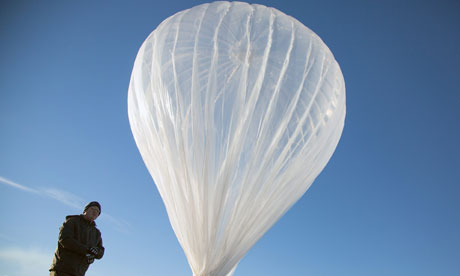
A Project Loon launch in New Zealand. Photograph: John Shenk/EPA", Source: the Gaurdian,
http://www.guardian.co.uk/technology/2013/jun/15/project-loon-google-balloon-internet
http://www.guardian.co.uk/technology/2013/jun/15/project-loon-google-balloon-internet
While the idea is smart and cost-effective, Google, like most big organizations and even countries, is beginning to learn that its hardest challenges are not technological [3-4]. The problem is beyond local, state, or governmental bureaucracy, it is international bureaucracy! [4] Loon project needs to cross borders of many countries with different politics and rules. For example, Texas and Tehran happen to be in the same altitude [3]. Will a Google balloon make its way to Iran's aerospace or China's? I am curious to see how Google manages to connect the world on internet! It seems like Google was well-aware and willing to take on these challenges and they chose this name, Loon, partly to recognize the strange and seemingly unrealistic goals they want to achieve! [5] Regardless, any new country and region they give broadband internet access to, be it in Africa or Asia, connecting children and adults to educational and informative resources, is a great service to humanity.
On June 16, 2013 Google started a trial of this project with 30 balloons over New Zealand! After this pilot run, Google plans on sending 300 balloons to cover areas in Argentina, Australia, New Zealand, and Chile, and later on Google dreams of having thousands of such balloons in stratosphere[5]
I talk about another Google effort for providing internet access to people all over the world in a second post.
To learn more about the Loon project please check out the references below.
References:
[1] http://www.google.com/loon/
[2] http://www.telegraph.co.uk/sponsored/technology/technology-trends/10162043/google-project-loon.html
[3] http://gigaom.com/2013/06/21/project-loon-googles-biggest-obstacle-isnt-technology-its-politics/
[4] http://www.forbes.com/sites/timworstall/2013/06/23/googles-project-loon-problem-international-bureaucracy/
[5] http://en.wikipedia.org/wiki/Project_Loon
[6] http://www.guardian.co.uk/technology/2013/jun/15/project-loon-google-balloon-internet
Monday, July 1, 2013
MAVEN, Mars, and You!

Image Credit: NASA, http://www.nasa.gov/images/content/440014main_MAVEN2-full.jpg
Mars Atmosphere and Volatile Evolution Mission (MAVEN) is NASA's next mission to Mars, scheduled to launch in late 2013. This mission is tasked with understanding Mars' upper atmosphere. NASA invites you to send your name with a Haiku (short poem) to be send around Mars orbit on Maven spacecraft:
http://lasp.colorado.edu/maven/goingtomars/send-your-name/
The deadline is today, July 1, 2013! Leave your Mark in the outer space and feel free to share your poems as comments to this post. Please pay attention to the rules of the game and Haiku (made of 3 lines with specified syllabus numbers):
http://lasp.colorado.edu/maven/goingtomars/contest-rules/
To learn all about Maven, please visit:
http://www.nasa.gov/mission_pages/maven/main/index.html#.UdGZaBblMRl
Wednesday, June 26, 2013
June 26, 2013
June 26, 2013 is recorded in the U.S. history forever, as the day that an individual named Edie Windsor won a case against the United States in the Supreme Court because she believed her constitutional rights were violated. Her action and victory does not only affect the many gay or lesbian partners or their children, but sends a strong message to generations to come: when you believe you have a case, you have a case. Go get your right, and know that the foundations of a healthy democracy and justice system is all you need. If you are lucky enough to have such structures in place in your society, you better honor such a system by using it for the purposes it was designed for to its fullest extent and capability. If you do not have such a system in place, you need to help build one!

It has not been even a week since the Supreme Court has passed this ruling, five days and three working days to be exact. Today, my colleagues and I received an email from our Human Resources office indicating those who are in same-sex marriages, can now add their spouses and children to their health insurance policy, that they can benefit from other benefits for child care, retirement, etc just as any other spouse or child of a family would. I was proud of seeing the power of law and democracy in action and how quickly a new law gets implemented. For me, seeing that email was historic for the reasons I mentioned and more; among them for the respect the people have for the law. I am sure there are many religious people not happy with this ruling. But once the case has gone through all the steps of a justice system, once the game is over, they accept the verdict. If they do not, they revisit the case in the court of law not in streets with destructions, bullets, and chaos. Today, I was proud of America and Americans.

It has not been even a week since the Supreme Court has passed this ruling, five days and three working days to be exact. Today, my colleagues and I received an email from our Human Resources office indicating those who are in same-sex marriages, can now add their spouses and children to their health insurance policy, that they can benefit from other benefits for child care, retirement, etc just as any other spouse or child of a family would. I was proud of seeing the power of law and democracy in action and how quickly a new law gets implemented. For me, seeing that email was historic for the reasons I mentioned and more; among them for the respect the people have for the law. I am sure there are many religious people not happy with this ruling. But once the case has gone through all the steps of a justice system, once the game is over, they accept the verdict. If they do not, they revisit the case in the court of law not in streets with destructions, bullets, and chaos. Today, I was proud of America and Americans.
Subscribe to:
Posts (Atom)