Wednesday, June 26, 2013

June 26, 2013

June 26, 2013 is recorded in the U.S. history forever, as the day that an individual named Edie Windsor won a case against the United States in the Supreme Court because she believed her constitutional rights were violated.  Her action and victory does not only affect the many gay or lesbian partners or their children, but sends a strong message to generations to come: when you believe you have a case, you have a case.  Go get your right, and know that the foundations of a healthy democracy and justice system is all you need.  If you are lucky enough to have such structures in place in your society, you better honor such a system by using it for the purposes it was designed for to its fullest extent and capability. If you do not have such a system in place, you need to help build one!


It has not been even a week since the Supreme Court has passed this ruling, five days and three working days to be exact.   Today, my colleagues and I received an email from our Human Resources office indicating those who are in same-sex marriages, can now add their spouses and children to their health insurance policy, that they can benefit from other benefits for child care, retirement, etc just as any other spouse or child of a family would.  I was proud of seeing the power of law and democracy in action and how quickly a new law gets implemented.  For me, seeing that email was historic for the reasons I mentioned and more; among them for the respect the people have for the law.  I am sure there are many religious people not happy with this ruling.  But once the case has gone through all the steps of a justice system, once the game is over, they accept the verdict.  If they do not, they revisit the case in the court of law not in streets with destructions, bullets, and chaos.  Today, I was proud of America and Americans.

Sunday, June 2, 2013

QE2s

As most of you know the name of the asteroid 1998 QE2 reminds many of the cruise ship QE2.  This nice video tells you how the properties of the QE2 of the skies relates to those of the seas:


Reference:
http://www.youtube.com/watch?feature=player_embedded&v=Gp8576W8QHU#!

Thursday, May 30, 2013

1998 QE2

During the past weeks we have heard about asteroid 1998 QE2 and how it has got closer than any other asteroid to Earth.  Whether or not it poses any dangers to us or not (well, it does not). In fact, the closest approach of this asteroid to Earth occurs tomorrow, May 31, 4:59 pm Eastern Time, "when the asteroid will get no closer than about 3.6 million miles (5.8 million kilometers), or about 15 times the distance between Earth and the moon". As eyes were on this asteroid to capture this approach, NASA scientists discovered that QE2 has its own moon!   Radar data of NASA's Goldstone Deep Space antenna in California were used for this finding.  Images were taken from "3.75 million miles (6 million kilometers) from Earth, which is 15.6 lunar distances." To learn more read here.

Yet, I wonder, where is my moon?  I mean Vesta's moon?


Reference:

http://www.nasa.gov/mission_pages/asteroids/news/asteroid20130530.html


Wednesday, May 15, 2013

Magnetospheric Multiscale Mission

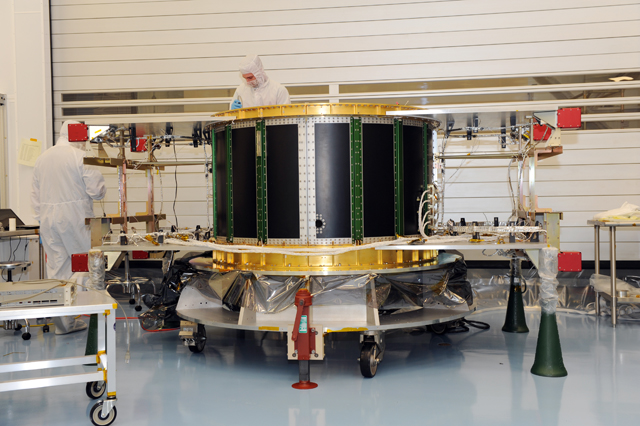
Designing, building, launching, and operating a spacecraft is hard and detailed enough, requiring many hours of manpower at every stage.  Recently, there have been missions that launched two spacecrafts to work together to achieve mission goals.  Stereo for studying the Sun and GRAIL for studying the moon are examples of such missions.  It seems like we have built so much confidence and got bold enough to try a mission with 4 spacecrafts:  Magnetospheric Multiscale  (MMS) Mission.


MMS will do something unique:  it studies how the Earth's and Sun's magnetic fields connect and disconnect, and as a result  transfer energy to Earth and other planets in a process called reconnection. MMS uses 4 identical spacecrafts spaced in Earth's orbit, to obtain 3-dimensional data of the magnetospheric boundary to study this process.  MMS  uses the Earth's magnetosphere as a natural laboratory that can be directly studied.

MMS is being built in NASA Goddard Space Flight Center and is currently scheduled to launch in October 2014.  The mission is similar to ESA's Cluster mission with more spatial and temporal resolution, allowing to study the electron diffusion region.

References:
[1] Magnetospheric Multiscale  (MMS) Mission.
[2] http://www.nasa.gov/centers/goddard/news/topstory/2009/mms_magnetic.html
[3] http://mms.gsfc.nasa.gov/about_mms.html
[4] http://en.wikipedia.org/wiki/Magnetospheric_Multiscale_Mission
[5] http://en.wikipedia.org/wiki/Cluster_mission

Tuesday, March 12, 2013

How does it work?

Yesterday morning on the way to work, NPR was broadcasting an interview with Sheryl Sandberg and her new book Lean In was mentioned and discussed.  Then, when I arrived home, she was on the cover page of the weekly Time magazine that I receive in mail.  At night, I saw Piers Morgan had a piece on her and 60 Minutes a program on her.  How is it that everyone has a program or release about her on the same exact date?  Did they all want to be the first and that was the only way to avoid their content being out dated?  But how do they learn about the timeline and schedule of other competitive media.  Today, TED reshared an old video of her famous talk, "Why we have too few women leaders", on facebook too.  It is as if over night, the world decided to concentrate on her.  What happened? How does it work?

Was her book released yesterday?

Sunday, March 3, 2013

Word of the day

Uxorious (adjective): someone who is foolishly and madly in love with his wife and is affectionatly submissive to her.

Hard to know if this word has a positive or negative connotation! ;-)

Friday, March 1, 2013

Earth's Third Radiation Belt!

It was over 50 years ago in 1958 that Explorer 1 and Explorer 3 confirmed the existence of two radiation belts around Earth under Dr. James Van Allen's direction [1].  Van Allen Probes, previously called Radiation Belt Storm Probes (RBSP), were launched on August 30, 2012.   The objective of this mission, as its name suggests,  is to

"study two extreme and dynamic regions of space known as the Van Allen Radiation Belts that surround Earth. Named for their discoverer, James Van Allen, these two concentric, donut-shaped rings are filled with high-energy particles that gyrate, bounce, and drift through the region, sometimes shooting down to Earth's atmosphere, sometimes escaping out into space. The radiation belts swell and shrink over time as part of a much larger space weather system driven by energy and material that erupt off the sun's surface and fill the entire solar system." [2]

While most satellites are designed to turn off during intense radiation bombardments,Van Allen Probes are built to operate, tolerate, and collect data during such harsh conditions.

It is thus so fortunate and fitting that NASA Scientists have discovered a third radiation belt around our very own home planet Earth using Van Allen Probe's data soon after its launch [3].  To learn more about this discovery, please visit here.

Credit: NASA/Van Allen Probes/Goddard Space Flight Center.


This discovery is a humbling reminder that there is a lot yet to be learned about our home, Earth, let alone other planets and corners of this vast universe.

References:
  1. http://en.wikipedia.org/wiki/Van_Allen_radiation_belt 
  2. http://www.nasa.gov/mission_pages/rbsp/mission/index.html
  3. http://www.nasa.gov/mission_pages/rbsp/news/third-belt.html